

|
|
The Third Non-LTE (Local Thermodynamic Equilibrium) Kinetics Workshop (NLTE-3)
December 1-5, 2003
NIST, Gaithersburg MD
Submission of
Calculations
This document is intended to define the particulars of the workshop submissions. In the sections below, we will define the case problems, the comparison quantities which we require, and the detailed format of the data files which we will be expecting. The case problems are of two types: steady-state and time-dependent. These problems are completely defined by a specification of the electron temperature and electron or ion density. For the time-dependent cases, these quantities are provided as a time history. With the large number of case studies included in these two categories, we have avoided additional variations on the general NLTE problem, i.e. we specifically request that there be no consideration of optical depth, radiative transfer, or heavy-particle interactions. (The non-Maxwellian electron effects, however, are included in one of the cases.) These interesting topics are best deferred to later meetings.
An ftp/http server will be set up early summer 2003 to serve our needs for this workshop, and an email containing the relevant details will be distributed among the potential participants. Although the specific data transfer mode is still under consideration (ftp uploading being the primary candidate), it would be most convenient if the contributor created an archive file containing all the individual result files. Submissions employing such data compression techniques as zip/gzip/bzip2/arj/lha/rar along with the Unix tar archiving utility will be accepted. Please contact Yuri Ralchenko (email: yuri.ralchenko@nist.gov) if other compression/archiving options are necessary. An example submission file will be provided on the ftp server for comparisons.
Timeline:
I. STATEMENT OF STEADY-STATE CASES
We have selected a number of atoms to consider, and for each atom are requesting results on a grid of electron temperatures and electron or ion (for the Xe case only) densities. In the following, temperatures are given in eV (1 eV = 1.602 176 462 · 10-19 J) and particle densities in cm-3.
The following problems have been established for the steady-state cases:
|
Element |
Case
ID |
Total
# of Points |
Parameter |
Grid
|
# of
Points |
|---|---|---|---|---|---|
|
Carbon |
C |
7 |
Te |
10, 15, 20, 30, 45,
60, 80 |
7 |
|
|
|
|
Ne |
1022 |
1 |
|
|
|
|
|
|
|
|
Aluminum |
Al |
14 |
Te |
50, 70, 100, 150,
200, 400, 800 |
7 |
|
|
|
|
Ne |
1020, 1022 |
2 |
|
|
|
|
|
|
|
|
Argon |
Ar |
24 |
Te |
100, 300, 600, 1000 |
4 |
|
|
|
|
Ne |
1012, 1018,
1023 |
3 |
|
|
|
|
Thot |
10 000 eV at 0% and
10% of Ne |
2 |
|
|
|
|
|
|
|
|
Germanium |
Ge |
12 |
Te |
150, 250, 400, 600 |
4 |
|
|
|
|
Ne |
1017, 1020,
3×10²² |
3 |
|
|
|
|
|
|
|
|
Germanium |
GeTr |
11 |
Te |
150, 250, 400, 600 |
4 |
|
|
|
|
Ne |
3×10²² |
1 |
|
|
|
|
Trad |
Te/2, Te,
300 |
3 |
|
|
|
|
|
|
|
|
Xenon |
Xe |
6 |
Te |
200, 375, 415, 455,
600, 750 |
6 |
|
|
|
|
Ni (ion!) |
4.75×10¹⁸ |
1 |
|
|
|
|
Spectrum |
9−120 Å |
2221 |
|
|
|
|
|
|
|
|
Gold |
Au |
18 |
Te |
750, 1500, 2500 |
3 |
|
|
|
|
Ne |
1019, 1020, 1021, 1022, 1023,
1024 |
6 |
|
|
|
|
|
|
|
Table I. Steady-state case definitions.
The grid of plasma
temperatures and densities is given in Table I. If your calculation requires an
ion temperature, then you should assume it is identical to the electron
temperature.
In case of argon calculations, 10% of the hot electrons means 10% of the total electron density given by Ne. Thus, for instance, for Ne = 1018 cm-3 the density of hot electrons would be 1017 cm-3 while the density of the bulk thermal electrons would be 9×1017 cm-3. The hot electrons are to be presented as a second Maxwellian with the temperature of 10 000 eV.
Each calculation will be referenced by a case name, which is to be given in the submissions data file (as described further below). The case name is constructed by appending a suffix to the Case_ID shown in the preceding table. The suffix consists of a digit, a letter and, for Ar and GeTr cases only, a digit. The first digit identifies the problem temperature, while the letter indicates the electron density. For the Ar case, the final digit is 1 for 0% of hot electrons and 2 for 10% of hot electrons. For the GeTr case, the final digit is 1, 2 or 3 for Trad = Te/2, Te or 300, respectively. Thus, the case name Al3b refers to the third temperature and second density of the aluminum steady-state grid, namely 100 eV and 1022 cm-3. The name GeTr4a2 refers to germanium at Te = 600 eV, Ne = 3×1022 cm3, and Trad = Te.
The quantities to be computed for each case are described below. The Xe case additionally requires calculation of emission spectra. The emissivity of the xenon plasma is to be calculated in the wavelength range of 9-120 Å[1].
In all the above cases, the calculations are to be solved in steady-state, at the specified electron densities and temperatures. In all but the GeTr cases the radiation field should be zero − only spontaneous radiative decays and radiative recombination shall be included – while for the GeTr case we request the photoinduced processes (photoionization, photoexcitation, stimulated emission, etc.) to be added as well.
For both steady-state and time-dependent cases the submissions file should be named as <case>.<contributor_name>.<code_name>, so that Dr. A. Einstein’s calculations for one of the hot-electron cases in Argon with his code GTOE would be in the file ar2c2.einstein.gtoe (case insensitive).
II. JUSTIFICATIONS OF THE STEADY-STATE CASES
Since the NLTE-1 comparisons for carbon cases have shown quite a good agreement for lower densities of 1016 and 1020 cm-3, here we would like to study the highest-density case for which the codes produced the mostly divergent results.
Aluminum cases for NLTE-1 have showed a wide spread for temperatures below 200 eV and all densities. Correspondingly, the number of low-Te points is increased here.
For argon, a rather good agreement was found in NLTE-1, mostly since the high temperatures shift the ion distribution towards He- and H-like ions. Here we, first, add lower temperatures and second, ask for calculations with hot electrons.
To move the comparisons toward
higher atomic number we have attempted to take cases motivated by experiment.
Thus we choose this Ge (Z=32) steady-state case to provide further information on
the same Te and Ne range that is used in the TD-Ge
case which was motivated schematically by the transient collisional laboratory
X-ray laser scheme. We have done this in the hopes of a) reducing the number of
kinetics models that need to be constructed and b) providing further insight in
the TD-Ge case.
To test the various aspects of the
code with respect to radiation fields we have taken the simplest form of the
problem. That is, we impose a Planckian radiation field at the specified
radiation temperature Trad.
6.
Xe
This is the
most “experiment-related” case inspired by the recent both published (Phys.
Rev. E 65, 046418, 2002) and yet unpublished measurements by C.
Chenais-Popovics et al. The measurements were aimed “…at validating recent calculation
techniques for the emission properties of medium- and high-Z multicharged ions
in hot plasmas." The fundamental plasma parameters, such as electron
temperature, electron density and average charge state, were deduced from
electronic and ionic Thomson scattering spectra, so that the calculated spectra
could be directly compared to experimental data.
Here we would like to explore the rapid changes in ion distribution which seems to strongly depend not only on Te but on Ne as well.
III. STATEMENT OF TIME-DEPENDENT CASES
Three simple cases have been defined by temperature and density histories:
TD-C Impurity transport in a reversed-field pinch.
TD-Ar Implosion of argon plasma in a capillary discharge.
TD-Ge Germanium X-ray laser plasma.
For all time-dependent cases the time grid is linear starting from t = 0. The exact time grids as well as the electron temperature and density histories for each case are provided in the Appendix. The calculated data are to be provided at each time step.
We would like to emphasize that although the proposed cases are motivated by some particular experiments, the presented time histories are not necessarily identical to those determined in various measurements. This was done intentionally in order to enhance some or to diminish other physical processes taking place in the plasmas.
The TD-C case of the NLTE-1 was devoted to recombination of high-density plasma of carbon. Here we propose a low-density case which is related to the reversed-field pinch experiment. The impurity emission during its transport across the experimental device is widely used for diagnostics of this type of plasma. The major process here is also recombination although at a much lower density. The electron temperature and density are presented in Fig. 1. This calculation should be carried out to t = 200 ms. The initial condition is that all the population is in the bare ion. Output should be provided at t = 0 and thereafter at 40 uniformly spaced times spanning the range 5 to 200 ms. The intensities of the Lyα and Heα (W) and intercombination (Y) lines in C V and C VI are requested as well.
The TD-Ar case is inspired by the implosion of argon inside capillary discharge used in the studies of the collisional X-ray laser. However, the Ne and Te are, correspondingly, lower and higher than those in the X-ray laser capillaries. For this case all population at time t=0 is in the ground state of Ar VI or, only if Ar VI is not included in the model, in the ground state of the lowest-charge ion. The history of the electron temperature and density is presented in Fig. 2; the calculation should be carried out to t = 50 ns.
In Figure 3 we show the time history of Te (left hand axis) and Ne (right hand axis) for the TD-Ge case, which is motivated by the germanium X-ray laser experiments. This calculation should be carried out to t = 1.975 ns, and the non-uniform time grid along with the corresponding values of Te and Ne are presented in the Appendix. The initial condition is LTE.
Case |
Initial Condition |
# Output Times |
Output Δ |
Stop Time |
|
TD-C |
bare ion |
41 |
5 ms |
200 ms |
|
TD-Ar |
Ar VI g.s. |
51 |
1 ns |
50 ns |
|
TD-Ge |
LTE |
83 |
variable |
1.975 ns |
Table III. Summary of parameters for time-dependent calculations.
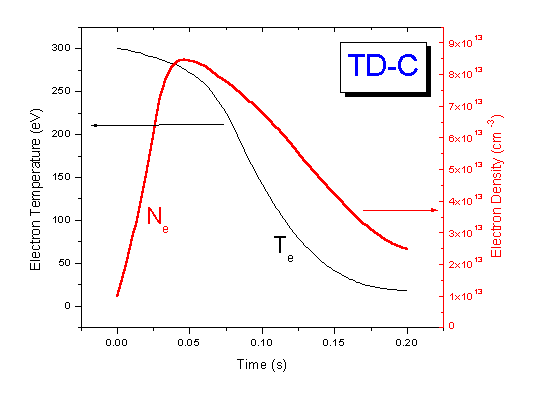
Fig 1. Time history of plasma parameters for TD-C.
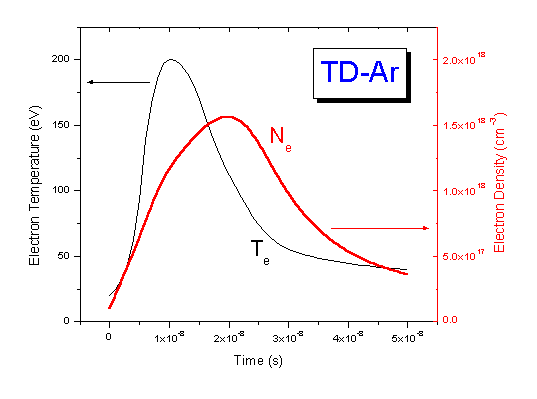
Fig. 2. Time history of plasma parameters for TD-Ar.
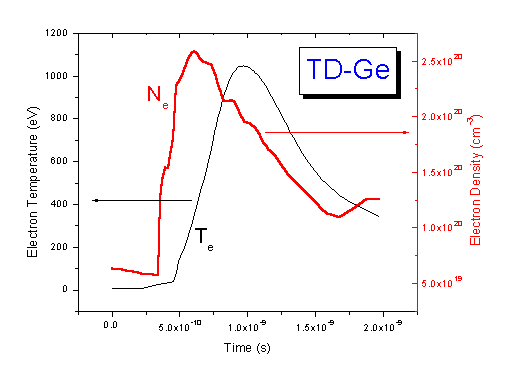
Fig. 3. Time history of plasma parameters for TD-Ge.
IV. SUBMISSION FILE DESCRIPTION
We are asking for a fairly large amount of information by comparison with the opacity workshops. To simplify the specification for the contributors we have adopted a keyword approach within the submissions file. In this approach, all quantities are space delimited. In Section V, we give a schematic of the file format. For clarity we will use the courier font to indicate the keywords (the actual submissions should be unformatted text). The user-supplied data which are problem-dependent are indicated by a bold-face parameter name in brackets (e.g., <pop_frac>). We anticipate that not all information will be provided by every user. However, since the information is space delimited, and not fixed in a particular column, then some value must be given for each field. The best default value is to put a zero. The longer records, such as the ion and elev lines, may continue over several lines at the contributor’s discretion. Do not break a line in the middle of a keyword or a number. Blank lines may be used anywhere within the file to make the text more readable. While some of the names we use suggest integer quantities, please use decimal values if appropriate to your calculation. For floating point numbers an e11.4 format is generally adequate. The exact definitions of the quantities requested, including units, are given in Section V.
The submissions file is structured in 5 sections. These sections are identified by keywords. In some cases, an integer follows the section keyword to indicate the number of records which follow for that section. Some codes will not be able to provide information for every section. Thus, an entire section may be omitted. If all information is provided, then there will be a certain amount of redundancy. This redundancy is intentional and has at least two uses. First, it can be used to detect errors in the file formatting. Second, it is often possible to compute overall quantities more accurately internal to the kinetics code than by post-processing the results.
The initial section provides general problem identification information. This section begins with the keyword data.
The sections 2-4 constitute a set of output data which is to be generated at each time step for the time-dependent problems. Naturally, only one such set should be produced for the steady-state cases.
The second
section gives overall quantities describing the plasma population and
energy distribution. This section is signaled by the keyword summary_quantities. Note there are no spaces in the keywords.
The third
section gives information by ionization stage. This section is signaled by
the keyword ion_stages. Within this section, information for each ionization
stage begins with the keyword ion. As mentioned above,
multiple lines may be used if desired (we intentionally used multiple lines in
the schematic file listing below to improve its readability). Important note:
we use <Nbound>, the number of bound electrons, not the ion stage charge, to label the
ion stages.
The fourth section gives information by energy level (keyword energy_levels). Since many codes employ some form of continuum lowering and/or moving calculational windows, we require that energy level definitions be provided for every case. The shell occupation numbers (<occK>, <occL> etc.) as defined for each elev record will be used to compare codes for the cross-over from a ladder-like de-excitation regime to one which is in Saha-Boltzmann equilibrium with the continuum.
Finally, the fifth section contains spectra intensities, either for a prescribed spectral range (steady-state) or for some specific lines (time-dependent).
A relational database tool will be used to manage the data during the course of the workshop. To simplify the data access, the database layout will parallel the file formats specified here.
If
necessary, extra clarifications regarding the submission format will be
provided at the Workshop’s web site.
The text that follows is a schematic of a submissions file:
data <user comment... >
case <case_id>
code <name>
atom <name> <Znuc>
summary_quantities
plasma <Te> <Ne>
time <time>
zbar <zbar>
m2 <2nd central moment>
m3 <3rd central moment>
m4 <4th central moment>
eint
<internal_energy>
deintdt <dEint/dTe>
pfn <partition_fn>
nmax_eff <n_value>
ion_stages <count>
ion <Nbound> <pop_frac> <nouter>
<Stot> <f_Scoll> <f_Sphoto> <f_Sauto>
<αtot>
<f_αcoll> <f_αphoto> <f_αauto>
...
ion
<Nbound> <pop_frac> <nouter>
<Stot> <f_Scoll> <f_Sphoto> <f_Sauto>
<αtot> <f_αcoll> <f_αphoto> <f_αauto>
energy_levels
<count>
elev
<Nbound> <level1> <stwt> <energy>
<population>
<Γtot> <f_ΓcollBB> <f_ΓphotoBB> <f_ΓcollBF> <f_ΓphotoBF> <f_Γauto>
<occK> <occL> <occM> ... <nouter>
...
elev
<Nbound>
<levelN> <stwt> <energy> <population>
<Γtot> <f_ΓcollBB> <f_ΓphotoBB> <f_ΓcollBF> <f_ΓphotoBF> <f_Γauto>
<occK> <occL> <occM> ... <nouter>
…
…
summary_quantities
plasma <Te> <Ne>
time <time>
…
ion_stages <count>
…
energy_levels
<count>
…
summary_quantities
plasma <Te> <Ne>
time <time>
…
ion_stages <count>
…
energy_levels
<count>
…
For the cases where we request spectra, the output format is different for Xe and TD-C cases. The spectral information will be given in this same text file, following the information above. The Xe spectrum will be in the format:
spectrum Xe
<count>
<wavelength1> <εbb1> <εbf1> <εff1> <εtot1>
<wavelength2> <εbb2> <εbf2> <εff2> <εtot2>
...
<wavelengthN> <εbbN> <εbfN> <εffN> < εtotN>
The TD-C spectrum will be in the format:
spectrum TD-C
<count>
<time1> <Ly1> <W1> <Y1>
<time2> <Ly2> <W2> <Y2>
…
… … …
<timeN> <LyN> <WN> <YN>
VI. DEFINITIONS OF REQUESTED QUANTITIES
Before proceeding to a
detailed description of the requested quantities, we would like to comment on
the ion density. For all but the TD-C
case the electron and ion densities are directly related via the plasma
neutrality condition, i.e.,  . Thus, for the Xe case the electron density is to be
determined from the plasma average charge and the known ion density. For the TD-C case, where carbon is an impurity in the
reversed-field pinch plasma, we accept that the carbon ion density is
. Thus, for the Xe case the electron density is to be
determined from the plasma average charge and the known ion density. For the TD-C case, where carbon is an impurity in the
reversed-field pinch plasma, we accept that the carbon ion density is 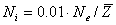 .
.
In section 1, the identification section, the following quantities are requested:
data Calculation identifier and user comment line. Comment should be limited to this one line only and should include the contributor’s name, institution, the version of the code, and the date at which calculation was run. This can be invaluable in maintaining order in large number of submissions.
case All steady-state and time-dependent calculations will have a case identification of the form Au1b, C6a or the like (see Section I). These identifiers are assigned in the section below where the specific calculations are called out.
code An identifier for each contributor's code which may be chosen by the contributors. For convenience in post-processing and tabulation the names should not be excessively long. The names will be used in all tables and graphs of comparisons, and must be the same from case to case.
atom Identifies the atom under study. The field <name> is a convenience for the contributor. In many cases, calculations are driven by atomic data found in a file. The file <name> may be used to specify that name. The field <Znuc> is the nuclear charge of the atom.
As has already been explained above, the group of sections summary_quantities, ion_stages and energy_levels repeats for each time step for the time-dependent cases.
In section 2, the summary_quantities section, the following items are requested:
plasma This record specifies the plasma conditions used in this calculation. The electron temperature is in units of eV. The electron density is in units of cm-3. For time-dependent cases both Te and Ne may be arbitrary.
time The
output time for time-dependent cases or zero for steady-state cases.
zbar The average charge of the plasma.
m2 The second central moment of the charge state distribution.
m3 The third central moment of the charge state distribution.
m4 The fourth central moment of the charge state distribution.
eint The specific internal energy of the atom.
deintdt The "specific heat" of the atom.
pfn The "partition function" of the atom.
nmax_eff For this calculation, the principal quantum number of the outermost electron in any bound state. We will be interested in sensitivity of comparison quantities to the highest bound states accounted for by the model. This quantity will also be used as a measure of continuum lowering.
The central moments are defined as:
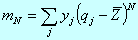
where yj
is the fractional population of ion stage j, qj is the ion
charge, and  is the average charge.
The specific internal energy is the sum of level populations, nj, multiplied by their energy value, Ej, divided by the total ion density Ni:
 .
.
The energy reference is the ground state of the neutral atom. We recognize that a kinetics model may not include all ionization stages of the atom – the ground state of the most neutral ion is the most reasonable substitute. For intercomparisons, this quantity will likely need zero point shifts. Units are eV/atom.
The specific heat is the derivative with respect to electron temperature of the specific internal energy of the atom. Units are eV/atom/eV. If computed by finite difference, the step size is to be chosen by the contributor.
The partition function is defined as the classical partition function:
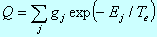 ,
,
where gj is the statistical weight of level j and Ej is the energy of the level, with respect to the ground state of the most neutral ion.
Note that many of the "thermodynamic" quantities are intentionally sensitive to continuum lowering models. Possibly affected quantities are <eint>, <deintdt>, and <pfn>. If your continuum lowering model alters the energy levels or statistical weights, please include these effects in the appropriate "thermodynamic" quantities.
High-lying bound states can be included in the population kinetics in a variety of ways. The field nmax_eff is intended to give information on the highest-lying bound state, which is affecting the calculation of the populations. It is thus an "effective" principal quantum number. If a code includes a level, which accounts for more than one n value, then for this field we recommend giving the largest value that is being modeled.
In section 3, the ion_stages section, the following quantities are requested:
<Nbound> The number of bound electrons in this ionization stage.
<pop_frac> The fraction of atoms in this ionization stage. Sum over all ions should be normalized to unity.
<nouter> The principal quantum number of the outermost electron for any state in this ion stage.
<Stot> The total ionization rate out of this ion stage, averaged over all initial states in this ion stage (weighted by the fractional populations of the initial states), and summed over all final states. This quantity is further summed over all ionization processes.
<f_Scoll> The fractional contribution of electron collisional ionization processes to <Stot>.
<f_Sphoto> The fractional contribution of photo-ionization processes to Stot>.
<f_Sauto> The fractional contribution of auto-ionization processes to <Stot>.
<αtot> The total recombination rate out of this ion stage, averaged over all initial states in this ion stage (weighted by the fractional populations of the initial states), and summed over all final states. This quantity is further summed over all recombination processes.
<f_αcoll> The fractional contribution of three-body recombination to the total <αtot>.
<f_αphoto> The fractional contribution of radiative-recombination to the total <αtot>.
<f_αauto> The fractional contribution of dielectronic capture processes to the total <αtot>.
We note that the total ionization and recombination rates are rates, and not rate coefficients. It is also important to be precise about the direction of these total rates. <Stot> is the total rate out of the indicated ion. Similarly, <αtot> is the total rate out of the ion.
The definitions of Stot and αtot are best clarified through an example. Consider a three-ion stage problem consisting of levels in Li-like, He-like, and H-like ions. For the He-like ion, Stot is the sum of all ionization rates out of He-like, weighted by the appropriate He-like initial state populations, and summed over all final states in the H-like ion. The averaging over initial states is completed by dividing the above sum by the total population of the He-like ion. αtot for the He-like ion is the sum of all recombination rates out of He-like, weighted by the appropriate He-like initial state populations, and summed over all final states in the Li-like ion. The averaging over initial states is completed by dividing the above sum by the total population of the He-like ion. With these definitions, we can define a set of ionization rate equations. In the case of the He-like ion, we write:
![\frac{dn(He)}{dt} = \alpha _{tot}(H) n(He) -[S_{tot}(He)+\alpha
_tot(He)]n(He) + S_{tot} n(Li)](NLTE3_files/image020.gif) .
.
Our primary interest is the collisional radiative modeling of highly-charged ions and so we have not requested detailed information for contributions due to other processes, such as charge-exchange and heavy ion collisions. Units of <Stot> and <αtot> are s-1.
In section 4, the energy_levels section, the following quantities are requested:
<Nbound> Identifies the ionization stage to which this energy level belongs. As always, this quantity is the number of bound electrons in the level.
<level> A sequential level number within this ionization stage. This index begins at 1 within each ionization stage for use as a label in model comparisons. The ground state of each ion stage will be identified by locating the state of lowest energy within the ion stage.
<stwt> The statistical weight of this energy level.
<energy> The energy of the level relative to the overall model. Ionization potentials will be obtained by subtraction of successive ground state energies. Units are in eV. The overall energy reference is the ground state of the most neutral ion in the problem.
<population> The ion density of this level. Units are cm-3.
<Γtot> The total destruction rate of this level. This is the absolute value of the corresponding term in the rate matrix diagonal. Units are s-1.
<f_ΓcollBB> The fractional contribution of electron collision excitation/de-excitation processes to <Γtot>.
<f_ΓphotoBB> The fractional contribution of bound-bound radiation processes to <Γtot>.
<f_ΓcollBF> The fractional contribution of electron collision ionization-recombination processes to <Γtot>.
<f_ΓphotoBF> The fractional contribution of photo-ionization-recombination to <Γtot>.
<f_Γauto> The fractional contribution of auto-ionization/dielectronic recombination processes to <Γtot>.
<occK> Occupation number: for this energy level, the number of electrons in the K shell. Users of configuration interaction codes might wish to use the dominant configuration to assign this value.
<occL> The number of electrons in the L shell.
...
<nouter> The principal quantum number of the outermost electron in that energy level.
The shell occupation numbers (<occK>, <occL>, etc.) could be variable in number for each code, plasma condition, and energy level. Contributors are not constrained on this point: they may specify as many shells as necessary, and as relevant to their calculational approach. The final entry for this energy level record should be the principal quantum number of the outermost electron in that level. In the case of highly-excited levels, the shell occupation numbers may be simplified by only specifying the core, <Nbound>-1, electrons. In this case the field <nouter> will be used to set the location of the remaining electron. We will be using the values given in this section to compute some of the quantities given in section 2 for consistency checks.
In section 5, the spectrum session, the data format is different for the Xe and TD-C cases. For the Xe case, the required data are bound-bound <εbb>, free-bound <εfb>, free-free <εff> and total <εtot> emissivities in units of erg/atom/s/Å (= 10-7 J/atom/s/Å). The field <count> specifies the number of (wavelengths, emissivities) rows which follow. The minimum and maximum wavelengths to be covered are 9 and 120 Å, respectively, and the wavelength mesh should consist of 2221 equally-spaced points (Δλ = 0.05 Å, λ1 = 9 Å, λ2 = 9.05 Å … λ2220 = 119.95 Å, λ2221 = 120 Å). The broadening should be natural+Doppler only. The uniform gridding will greatly simplify the spectrum comparison and post-processing operations (e.g., convolution with experimental broadening function).
For the TD-C case, the data required are the time-dependent intensities emitted per unit volume of the Lyα, W and Y lines in H- and He-like C. The intensity emitted per unit volume is defined as:
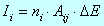
in units of erg/cm3/s (= 10-7 J/cm3/s), where Aij is the radiative transition probability (emission) and ΔE is the transition energy. No opacity effects are to be taken into account when calculating the intensities. The field <count> in this case would be 41 (number of time steps for TD-C).
APPENDIX. TIME HISTORIES FOR TIME-DEPENDENT CASES
Step # |
Time (s) |
Te |
Ne |
|---|---|---|---|
|
0 |
0.000E+00 |
3.000E+02 |
1.000E+13 |
|
1 |
5.000E-03 |
2.990E+02 |
1.790E+13 |
|
2 |
1.000E-02 |
2.970E+02 |
2.700E+13 |
|
3 |
1.500E-02 |
2.950E+02 |
3.730E+13 |
|
4 |
2.000E-02 |
2.920E+02 |
4.840E+13 |
|
5 |
2.500E-02 |
2.900E+02 |
6.070E+13 |
|
6 |
3.000E-02 |
2.870E+02 |
7.310E+13 |
|
7 |
3.500E-02 |
2.840E+02 |
8.050E+13 |
|
8 |
4.000E-02 |
2.810E+02 |
8.360E+13 |
|
9 |
4.500E-02 |
2.770E+02 |
8.460E+13 |
|
10 |
5.000E-02 |
2.720E+02 |
8.440E+13 |
|
11 |
5.500E-02 |
2.660E+02 |
8.380E+13 |
|
12 |
6.000E-02 |
2.590E+02 |
8.280E+13 |
|
13 |
6.500E-02 |
2.500E+02 |
8.130E+13 |
|
14 |
7.000E-02 |
2.380E+02 |
7.950E+13 |
|
15 |
7.500E-02 |
2.250E+02 |
7.790E+13 |
|
16 |
8.000E-02 |
2.090E+02 |
7.620E+13 |
|
17 |
8.500E-02 |
1.920E+02 |
7.430E+13 |
|
18 |
9.000E-02 |
1.740E+02 |
7.220E+13 |
|
19 |
9.500E-02 |
1.570E+02 |
7.030E+13 |
|
20 |
1.000E-01 |
1.420E+02 |
6.810E+13 |
|
21 |
1.050E-01 |
1.280E+02 |
6.580E+13 |
|
22 |
1.100E-01 |
1.140E+02 |
6.330E+13 |
|
23 |
1.150E-01 |
1.010E+02 |
6.080E+13 |
|
24 |
1.200E-01 |
8.950E+01 |
5.820E+13 |
|
25 |
1.250E-01 |
7.930E+01 |
5.530E+13 |
|
26 |
1.300E-01 |
6.990E+01 |
5.250E+13 |
|
27 |
1.350E-01 |
6.110E+01 |
4.980E+13 |
|
28 |
1.400E-01 |
5.330E+01 |
4.730E+13 |
|
29 |
1.450E-01 |
4.680E+01 |
4.480E+13 |
|
30 |
1.500E-01 |
4.140E+01 |
4.230E+13 |
|
31 |
1.550E-01 |
3.640E+01 |
3.980E+13 |
|
32 |
1.600E-01 |
3.190E+01 |
3.730E+13 |
|
33 |
1.650E-01 |
2.820E+01 |
3.510E+13 |
|
34 |
1.700E-01 |
2.520E+01 |
3.310E+13 |
|
35 |
1.750E-01 |
2.310E+01 |
3.120E+13 |
|
36 |
1.800E-01 |
2.150E+01 |
2.950E+13 |
|
37 |
1.850E-01 |
2.030E+01 |
2.800E+13 |
|
38 |
1.900E-01 |
1.940E+01 |
2.670E+13 |
|
39 |
1.950E-01 |
1.890E+01 |
2.560E+13 |
|
40 |
2.000E-01 |
1.880E+01 |
2.490E+13 |
2.TD-Ar
|
Step # |
Time (s) |
Te |
Ne |
|---|---|---|---|
|
0 |
0.00E+00 |
2.000E+01 |
1.000E+17 |
|
1 |
1.00E-09 |
2.463E+01 |
2.027E+17 |
|
2 |
2.00E-09 |
3.210E+01 |
3.083E+17 |
|
3 |
3.00E-09 |
4.431E+01 |
4.157E+17 |
|
4 |
4.00E-09 |
6.309E+01 |
5.239E+17 |
|
5 |
5.00E-09 |
9.319E+01 |
6.372E+17 |
|
6 |
6.00E-09 |
1.386E+02 |
7.566E+17 |
|
7 |
7.00E-09 |
1.666E+02 |
8.759E+17 |
|
8 |
8.00E-09 |
1.856E+02 |
9.887E+17 |
|
9 |
9.00E-09 |
1.971E+02 |
1.085E+18 |
|
10 |
1.00E-08 |
2.000E+02 |
1.164E+18 |
|
11 |
1.10E-08 |
1.991E+02 |
1.231E+18 |
|
12 |
1.20E-08 |
1.958E+02 |
1.290E+18 |
|
13 |
1.30E-08 |
1.897E+02 |
1.346E+18 |
|
14 |
1.40E-08 |
1.811E+02 |
1.399E+18 |
|
15 |
1.50E-08 |
1.695E+02 |
1.447E+18 |
|
16 |
1.60E-08 |
1.560E+02 |
1.489E+18 |
|
17 |
1.70E-08 |
1.433E+02 |
1.522E+18 |
|
18 |
1.80E-08 |
1.315E+02 |
1.546E+18 |
|
19 |
1.90E-08 |
1.212E+02 |
1.559E+18 |
|
20 |
2.00E-08 |
1.119E+02 |
1.562E+18 |
|
21 |
2.10E-08 |
1.031E+02 |
1.552E+18 |
|
22 |
2.20E-08 |
9.478E+01 |
1.528E+18 |
|
23 |
2.30E-08 |
8.716E+01 |
1.488E+18 |
|
24 |
2.40E-08 |
8.036E+01 |
1.432E+18 |
|
25 |
2.50E-08 |
7.436E+01 |
1.365E+18 |
|
26 |
2.60E-08 |
6.896E+01 |
1.289E+18 |
|
27 |
2.70E-08 |
6.424E+01 |
1.210E+18 |
|
28 |
2.80E-08 |
6.029E+01 |
1.132E+18 |
|
29 |
2.90E-08 |
5.719E+01 |
1.056E+18 |
|
30 |
3.00E-08 |
5.500E+01 |
9.846E+17 |
|
31 |
3.10E-08 |
5.355E+01 |
9.195E+17 |
|
32 |
3.20E-08 |
5.220E+01 |
8.601E+17 |
|
33 |
3.30E-08 |
5.093E+01 |
8.059E+17 |
|
34 |
3.40E-08 |
4.974E+01 |
7.564E+17 |
|
35 |
3.50E-08 |
4.863E+01 |
7.111E+17 |
|
36 |
3.60E-08 |
4.761E+01 |
6.698E+17 |
|
37 |
3.70E-08 |
4.668E+01 |
6.321E+17 |
|
38 |
3.80E-08 |
4.584E+01 |
5.979E+17 |
|
39 |
3.90E-08 |
4.510E+01 |
5.667E+17 |
|
40 |
4.00E-08 |
4.445E+01 |
5.384E+17 |
|
41 |
4.10E-08 |
4.390E+01 |
5.127E+17 |
|
42 |
4.20E-08 |
4.336E+01 |
4.894E+17 |
|
43 |
4.30E-08 |
4.281E+01 |
4.681E+17 |
|
44 |
4.40E-08 |
4.227E+01 |
4.487E+17 |
|
45 |
4.50E-08 |
4.176E+01 |
4.309E+17 |
|
46 |
4.60E-08 |
4.128E+01 |
4.146E+17 |
|
47 |
4.70E-08 |
4.085E+01 |
3.994E+17 |
|
48 |
4.80E-08 |
4.048E+01 |
3.852E+17 |
|
49 |
4.90E-08 |
4.020E+01 |
3.717E+17 |
|
50 |
5.00E-08 |
4.000E+01 |
3.587E+17 |
|
Step # |
Time (s) |
Te
|
Ne
|
|---|---|---|---|
|
0 |
0.0000E+00 |
6.5000E+00 |
6.3500E+19 |
|
1 |
5.2150E-12 |
6.5008E+00 |
6.3374E+19 |
|
2 |
1.0594E-10 |
6.4371E+00 |
6.1460E+19 |
|
3 |
2.1674E-10 |
6.3692E+00 |
5.9467E+19 |
|
4 |
3.3861E-10 |
2.4395E+01 |
5.7396E+19 |
|
5 |
3.5993E-10 |
2.7260E+01 |
1.2616E+20 |
|
6 |
3.7093E-10 |
2.8521E+01 |
1.4297E+20 |
|
7 |
3.9237E-10 |
3.1415E+01 |
1.5421E+20 |
|
8 |
4.1281E-10 |
3.3754E+01 |
1.5344E+20 |
|
9 |
4.3415E-10 |
3.5964E+01 |
1.6586E+20 |
|
10 |
4.5211E-10 |
3.8761E+01 |
1.8080E+20 |
|
11 |
4.7441E-10 |
8.2758E+01 |
2.2823E+20 |
|
12 |
4.9214E-10 |
1.3384E+02 |
2.3100E+20 |
|
13 |
5.1014E-10 |
1.7085E+02 |
2.3522E+20 |
|
14 |
5.3137E-10 |
2.0025E+02 |
2.4230E+20 |
|
15 |
5.5393E-10 |
2.4130E+02 |
2.4981E+20 |
|
16 |
5.7102E-10 |
2.7437E+02 |
2.5455E+20 |
|
17 |
5.9100E-10 |
3.1680E+02 |
2.5793E+20 |
|
18 |
6.1008E-10 |
3.5932E+02 |
2.5855E+20 |
|
19 |
6.3010E-10 |
4.0613E+02 |
2.5655E+20 |
|
20 |
6.5534E-10 |
4.6734E+02 |
2.5237E+20 |
|
21 |
6.7186E-10 |
5.0507E+02 |
2.5003E+20 |
|
22 |
6.9363E-10 |
5.6072E+02 |
2.4833E+20 |
|
23 |
7.1017E-10 |
6.0676E+02 |
2.4784E+20 |
|
24 |
7.2306E-10 |
6.4286E+02 |
2.4730E+20 |
|
25 |
7.3048E-10 |
6.6373E+02 |
2.4664E+20 |
|
26 |
7.3865E-10 |
6.8685E+02 |
2.4546E+20 |
|
27 |
7.5738E-10 |
7.4003E+02 |
2.4056E+20 |
|
28 |
7.6811E-10 |
7.7007E+02 |
2.3649E+20 |
|
29 |
7.7991E-10 |
8.0246E+02 |
2.3137E+20 |
|
30 |
7.9116E-10 |
8.3152E+02 |
2.2640E+20 |
|
31 |
8.0316E-10 |
8.6198E+02 |
2.2157E+20 |
|
32 |
8.1635E-10 |
8.9456E+02 |
2.1741E+20 |
|
33 |
8.2791E-10 |
9.1915E+02 |
2.1501E+20 |
|
34 |
8.4773E-10 |
9.5533E+02 |
2.1355E+20 |
|
35 |
8.5754E-10 |
9.7175E+02 |
2.1373E+20 |
|
36 |
8.6577E-10 |
9.8360E+02 |
2.1408E+20 |
|
37 |
8.7344E-10 |
9.9369E+02 |
2.1440E+20 |
|
38 |
8.8016E-10 |
1.0017E+03 |
2.1454E+20 |
|
39 |
8.9118E-10 |
1.0132E+03 |
2.1430E+20 |
|
40 |
8.9932E-10 |
1.0206E+03 |
2.1363E+20 |
|
41 |
9.0820E-10 |
1.0274E+03 |
2.1236E+20 |
|
42 |
9.1836E-10 |
1.0339E+03 |
2.1028E+20 |
|
43 |
9.2794E-10 |
1.0387E+03 |
2.0786E+20 |
|
44 |
9.3900E-10 |
1.0431E+03 |
2.0480E+20 |
|
45 |
9.4798E-10 |
1.0455E+03 |
2.0235E+20 |
|
46 |
9.5969E-10 |
1.0471E+03 |
1.9948E+20 |
|
47 |
9.7018E-10 |
1.0472E+03 |
1.9739E+20 |
|
48 |
9.7876E-10 |
1.0465E+03 |
1.9610E+20 |
|
49 |
9.8920E-10 |
1.0453E+03 |
1.9500E+20 |
|
50 |
9.9795E-10 |
1.0433E+03 |
1.9442E+20 |
|
51 |
1.0088E-09 |
1.0399E+03 |
1.9396E+20 |
|
52 |
1.0186E-09 |
1.0357E+03 |
1.9363E+20 |
|
53 |
1.0297E-09 |
1.0302E+03 |
1.9313E+20 |
|
54 |
1.0382E-09 |
1.0258E+03 |
1.9253E+20 |
|
55 |
1.0494E-09 |
1.0197E+03 |
1.9132E+20 |
|
56 |
1.0589E-09 |
1.0140E+03 |
1.8990E+20 |
|
57 |
1.0705E-09 |
1.0063E+03 |
1.8774E+20 |
|
58 |
1.0844E-09 |
9.9604E+02 |
1.8467E+20 |
|
59 |
1.0920E-09 |
9.8994E+02 |
1.8291E+20 |
|
60 |
1.1174E-09 |
9.6775E+02 |
1.7727E+20 |
|
61 |
1.1363E-09 |
9.4980E+02 |
1.7386E+20 |
|
62 |
1.1564E-09 |
9.2887E+02 |
1.7098E+20 |
|
63 |
1.1768E-09 |
9.0607E+02 |
1.6847E+20 |
|
64 |
1.1971E-09 |
8.8197E+02 |
1.6591E+20 |
|
65 |
1.2207E-09 |
8.5382E+02 |
1.6242E+20 |
|
66 |
1.2343E-09 |
8.3720E+02 |
1.6013E+20 |
|
67 |
1.2657E-09 |
7.9913E+02 |
1.5443E+20 |
|
68 |
1.2837E-09 |
7.7694E+02 |
1.5123E+20 |
|
69 |
1.3036E-09 |
7.5275E+02 |
1.4803E+20 |
|
70 |
1.3254E-09 |
7.2667E+02 |
1.4496E+20 |
|
71 |
1.3493E-09 |
6.9878E+02 |
1.4203E+20 |
|
72 |
1.3757E-09 |
6.6969E+02 |
1.3906E+20 |
|
73 |
1.4044E-09 |
6.3949E+02 |
1.3578E+20 |
|
74 |
1.4356E-09 |
6.0889E+02 |
1.3194E+20 |
|
75 |
1.4696E-09 |
5.7821E+02 |
1.2745E+20 |
|
76 |
1.5065E-09 |
5.4807E+02 |
1.2250E+20 |
|
77 |
1.5465E-09 |
5.1851E+02 |
1.1754E+20 |
|
78 |
1.5887E-09 |
4.9210E+02 |
1.1314E+20 |
|
79 |
1.6781E-09 |
4.4295E+02 |
1.0952E+20 |
|
80 |
1.7710E-09 |
4.0369E+02 |
1.1632E+20 |
|
81 |
1.8742E-09 |
3.6957E+02 |
1.2569E+20 |
|
82 |
1.9749E-09 |
3.4240E+02 |
1.2526E+20 |



 Inquiries or comments:
Feedback
Inquiries or comments:
Feedback